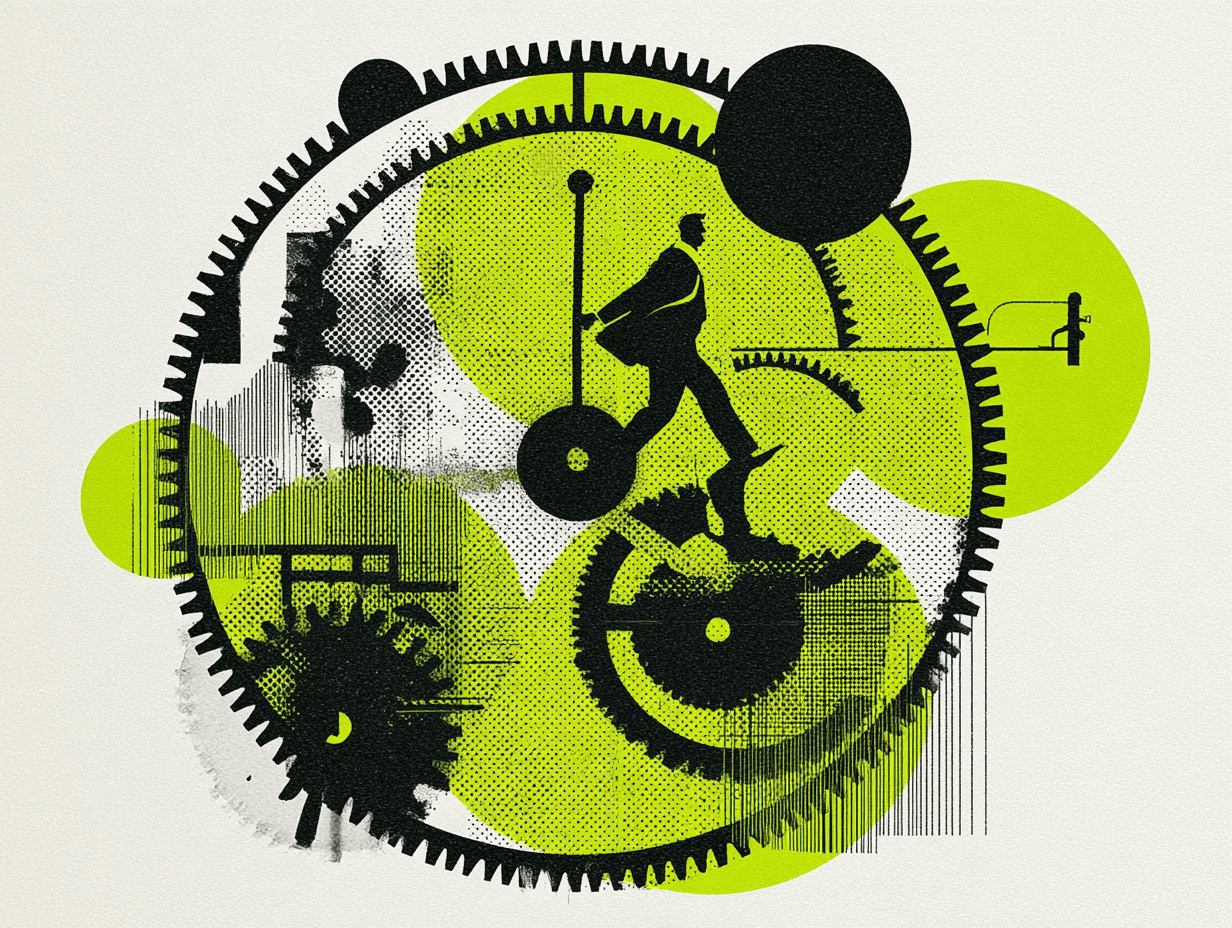
The Speed Trap: Why AI Isn't Actually Saving You Time

Jun 9, 2025

The Speed Trap: Why AI Isn't Actually Saving You Time

Jun 9, 2025

AI isn't giving you your time back. It's giving you more to do.

Some people believe AI will be our liberation. An age of automated tools, lightning fast productivity, and the offset of the mundane to machines that’ll supercharge our ability to build businesses, make revenue with tools that lowers the barrier for entry across every industry.

The promise of speed and ease sound good:

  • AI automates boring tasks so you focus on what matters

  • It handles grunt work while you tap into creativity

  • It compresses hours into minutes making you more efficient and productive

That's not really what happens though, at least not in isolation.

You use AI to write emails faster. Now you send twice as many.

You use AI to create content quicker. Now you're expected to be a one-person media company.

You use AI to streamline your workflow. Now your workflow includes ten tools that need your attention.


The Productivity Trap

Every technology promises the same thing: more leisure, less work, freedom from drudgery.

The printing press would free us from ignorance.

The washing machine would liberate women from housework.

Email would eliminate meetings.

What actually happened:

  • The printing press created information overload that demanded constant consumption

  • The washing machine raised cleanliness standards so high that laundry became more frequent

  • Email spawned meeting culture on steroids

The data tells the story. Despite decades of "labor-saving" devices, the average American work week barely changed. We work the same hours as people in the 1960s. We just have more tech assistance.

A Microsoft study found workers spend 21% more time in meetings than before the pandemic. Digital collaboration tools were supposed to streamline communication.

Technology doesn't eliminate work. It redefines what counts as work.

This hits marginalized communities hardest. When speed becomes currency, those who already do more with less must do even more. AI becomes the new measuring stick.

AI follows the same pattern. This time it's happening at warp speed across every industry.


The Hamster Wheel Accelerates

The real issue isn't technical. It's psychological and economic.

We treat speed as an end goal rather than a means to something else.

Think about your last AI "time-saver." What did you do with the time you saved?

You probably:

  • Took on more projects

  • Responded to more requests

  • Created more output

  • Found something else to speed up

  • Worried about falling behind people using AI "better"

It's never "I used AI to write this report, so now I'm going to the beach."

It's "I used AI to write this report, so now I can write three more reports."


What Are We Actually Optimizing For?

We confuse motion with progress. We measure success by output volume. We count tasks completed, not value created.

More content isn't better content.

More emails aren't better communication.

More meetings aren't better collaboration.

More speed isn't better thinking.

AI amplifies whatever system you put it into. Feed it a system designed around endless productivity and you get endless productivity. Just faster and more of it.

What if the system itself is broken?

The Speed Addiction

Every time AI makes something easier, we demand more. The bar for "easy enough" moves higher.

What took a week now takes a day. So weekly deadlines become daily deadlines.

What required a team now needs one person. So one person gets the workload of a team.

A 2024 Upwork survey found 96% of executives expect AI to boost productivity. But 81% also increased performance expectations for their teams in the past year.

The gains don't translate to reduced workloads. They translate to higher expectations.

We're not saving time. We're compressing it.

This creates psychological pressure to prove worth and stay relevant. When speed becomes a proxy for value, whose labor gets stretched? Whose humanity gets overlooked?

Instead of feeling accomplished for doing more with less, we feel behind for not doing even more.

The gains become demands.


The Real Cost

We're losing something more valuable than time: the space between things.

The commute that let your mind wander.

The slow process that forced deep thinking.

The boredom that sparked creativity.

The struggle that built expertise.

AI changes how we work. It also changes how we think, how we relate to our minds, and how we value our humanity.

When everything can be done instantly, nothing feels valuable. When every process can be sped up, we lose appreciation for what can't be streamlined.

Intuition. Serendipity. The messy human elements.


The Intentional Framework

Most of us have never asked what we're optimizing for.

We speed up how we work. We never question why we work.

We make processes faster without asking whether those processes should exist.

Every AI tool reflects back a question: What do you actually value?

Before you add another productivity tool, ask these four questions:


1. What outcome am I optimizing for?

Not the immediate output (faster emails, quicker reports). The actual outcome you want to create in your life or work.

Are you optimizing for impact? Learning? Connection? Financial security? Creative fulfillment?

Be specific.


2. Is that outcome aligned with what I actually value?

This gets uncomfortable fast.

You might optimize for "more content creation" when you actually value "meaningful creative expression."

You might optimize for "faster response times" when you actually value "thoughtful communication."

The speed might work against your deeper values.


3. Am I using this to do important work faster, or just more for the sake of?

This is the killer question.

If the work isn't important, making it faster just means you'll do more unimportant work.

Sometimes the best approach is elimination.

4. What will I do with the time, energy, or mental space this creates?

If you can't answer this specifically, you're creating a vacuum that will fill with more of the same.

The goal isn't to save time. It's to create space for what matters.

Here's the test: If your answer to question 4 is "I'll be able to do more work," you're not optimizing for speed. You're optimizing for busyness, for the allure of production, for the rate race of what capitalism is founded upon.


Breaking the Cycle

The solution isn't to abandon AI or reject speed.

Get clear about what speed is supposed to serve.

Ask yourself:

  • What am I optimizing for, and why?

  • What would I do with genuine free time?

  • What kinds of "slowness" do I actually value?

  • What am I willing to do deliberately?

  • Where do I want human friction to remain?

What if you used AI to do the same amount of work and then stopped?

What if speed was a tool for creating space, not filling it?

What if you only sped up things that matter so you can leave everything else beautifully, intentionally slow?


The Choice We're Not Making

Every time you add a new AI tool, you choose what kind of life you want.

You can choose the hamster wheel. Faster, smoother, more streamlined, but still a wheel.

Or you can choose something else.

The technology will do whatever you tell it to do. But you have to know what you actually want first.

The speed is real. The question is whether you'll use it to live more, or just to produce more.

The answer to that is probably the one thing AI can't optimize for you.


What are you actually optimizing for? Hit reply and let me know what you're seeing in your own relationship with AI and productivity.

AI isn't giving you your time back. It's giving you more to do.

Some people believe AI will be our liberation. An age of automated tools, lightning fast productivity, and the offset of the mundane to machines that’ll supercharge our ability to build businesses, make revenue with tools that lowers the barrier for entry across every industry.

The promise of speed and ease sound good:

  • AI automates boring tasks so you focus on what matters

  • It handles grunt work while you tap into creativity

  • It compresses hours into minutes making you more efficient and productive

That's not really what happens though, at least not in isolation.

You use AI to write emails faster. Now you send twice as many.

You use AI to create content quicker. Now you're expected to be a one-person media company.

You use AI to streamline your workflow. Now your workflow includes ten tools that need your attention.


The Productivity Trap

Every technology promises the same thing: more leisure, less work, freedom from drudgery.

The printing press would free us from ignorance.

The washing machine would liberate women from housework.

Email would eliminate meetings.

What actually happened:

  • The printing press created information overload that demanded constant consumption

  • The washing machine raised cleanliness standards so high that laundry became more frequent

  • Email spawned meeting culture on steroids

The data tells the story. Despite decades of "labor-saving" devices, the average American work week barely changed. We work the same hours as people in the 1960s. We just have more tech assistance.

A Microsoft study found workers spend 21% more time in meetings than before the pandemic. Digital collaboration tools were supposed to streamline communication.

Technology doesn't eliminate work. It redefines what counts as work.

This hits marginalized communities hardest. When speed becomes currency, those who already do more with less must do even more. AI becomes the new measuring stick.

AI follows the same pattern. This time it's happening at warp speed across every industry.


The Hamster Wheel Accelerates

The real issue isn't technical. It's psychological and economic.

We treat speed as an end goal rather than a means to something else.

Think about your last AI "time-saver." What did you do with the time you saved?

You probably:

  • Took on more projects

  • Responded to more requests

  • Created more output

  • Found something else to speed up

  • Worried about falling behind people using AI "better"

It's never "I used AI to write this report, so now I'm going to the beach."

It's "I used AI to write this report, so now I can write three more reports."


What Are We Actually Optimizing For?

We confuse motion with progress. We measure success by output volume. We count tasks completed, not value created.

More content isn't better content.

More emails aren't better communication.

More meetings aren't better collaboration.

More speed isn't better thinking.

AI amplifies whatever system you put it into. Feed it a system designed around endless productivity and you get endless productivity. Just faster and more of it.

What if the system itself is broken?

The Speed Addiction

Every time AI makes something easier, we demand more. The bar for "easy enough" moves higher.

What took a week now takes a day. So weekly deadlines become daily deadlines.

What required a team now needs one person. So one person gets the workload of a team.

A 2024 Upwork survey found 96% of executives expect AI to boost productivity. But 81% also increased performance expectations for their teams in the past year.

The gains don't translate to reduced workloads. They translate to higher expectations.

We're not saving time. We're compressing it.

This creates psychological pressure to prove worth and stay relevant. When speed becomes a proxy for value, whose labor gets stretched? Whose humanity gets overlooked?

Instead of feeling accomplished for doing more with less, we feel behind for not doing even more.

The gains become demands.


The Real Cost

We're losing something more valuable than time: the space between things.

The commute that let your mind wander.

The slow process that forced deep thinking.

The boredom that sparked creativity.

The struggle that built expertise.

AI changes how we work. It also changes how we think, how we relate to our minds, and how we value our humanity.

When everything can be done instantly, nothing feels valuable. When every process can be sped up, we lose appreciation for what can't be streamlined.

Intuition. Serendipity. The messy human elements.


The Intentional Framework

Most of us have never asked what we're optimizing for.

We speed up how we work. We never question why we work.

We make processes faster without asking whether those processes should exist.

Every AI tool reflects back a question: What do you actually value?

Before you add another productivity tool, ask these four questions:


1. What outcome am I optimizing for?

Not the immediate output (faster emails, quicker reports). The actual outcome you want to create in your life or work.

Are you optimizing for impact? Learning? Connection? Financial security? Creative fulfillment?

Be specific.


2. Is that outcome aligned with what I actually value?

This gets uncomfortable fast.

You might optimize for "more content creation" when you actually value "meaningful creative expression."

You might optimize for "faster response times" when you actually value "thoughtful communication."

The speed might work against your deeper values.


3. Am I using this to do important work faster, or just more for the sake of?

This is the killer question.

If the work isn't important, making it faster just means you'll do more unimportant work.

Sometimes the best approach is elimination.

4. What will I do with the time, energy, or mental space this creates?

If you can't answer this specifically, you're creating a vacuum that will fill with more of the same.

The goal isn't to save time. It's to create space for what matters.

Here's the test: If your answer to question 4 is "I'll be able to do more work," you're not optimizing for speed. You're optimizing for busyness, for the allure of production, for the rate race of what capitalism is founded upon.


Breaking the Cycle

The solution isn't to abandon AI or reject speed.

Get clear about what speed is supposed to serve.

Ask yourself:

  • What am I optimizing for, and why?

  • What would I do with genuine free time?

  • What kinds of "slowness" do I actually value?

  • What am I willing to do deliberately?

  • Where do I want human friction to remain?

What if you used AI to do the same amount of work and then stopped?

What if speed was a tool for creating space, not filling it?

What if you only sped up things that matter so you can leave everything else beautifully, intentionally slow?


The Choice We're Not Making

Every time you add a new AI tool, you choose what kind of life you want.

You can choose the hamster wheel. Faster, smoother, more streamlined, but still a wheel.

Or you can choose something else.

The technology will do whatever you tell it to do. But you have to know what you actually want first.

The speed is real. The question is whether you'll use it to live more, or just to produce more.

The answer to that is probably the one thing AI can't optimize for you.


What are you actually optimizing for? Hit reply and let me know what you're seeing in your own relationship with AI and productivity.

Let’s Make
Magic :)

Got a big idea, product, or message that needs to land? I work with teams ready to build things that connect and last. Reach out and let’s talk.

Contact us

Let’s Make
Magic :)

Got a big idea, product, or message that needs to land? I work with teams ready to build things that connect and last. Reach out and let’s talk.

Contact us

Let’s Make
Magic :)

Got a big idea, product, or message that needs to land? I work with teams ready to build things that connect and last. Reach out and let’s talk.

Contact us