Google Photos Gets Smarter: Leading the Team Behind Conversational Photo Editing

Nov 8, 2025

Google Photos Gets Smarter: Leading the Team Behind Conversational Photo Editing

Nov 8, 2025

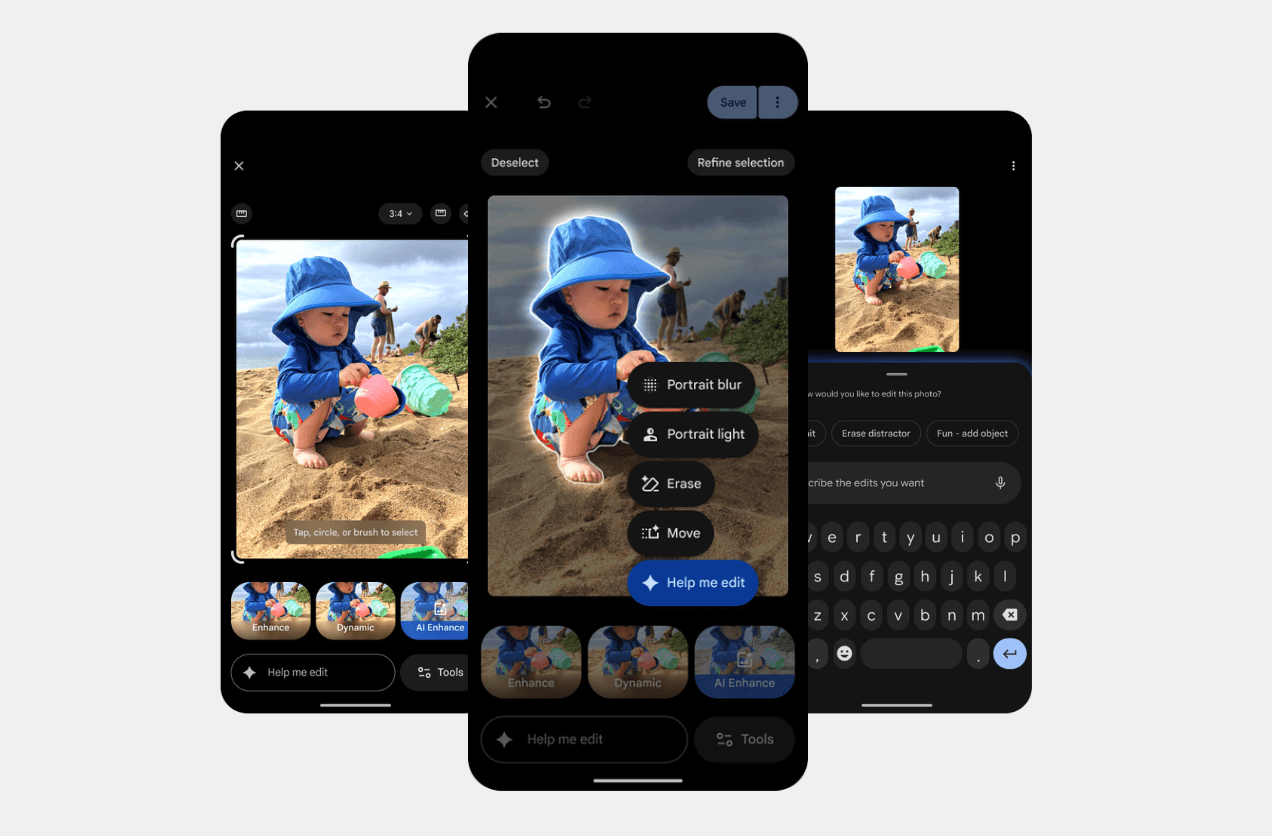
In September 2024, Google Photos launched a feature that felt like science fiction: ask your phone to edit your photo using natural language, and it just... does it.

"Blur the background." "Make this brighter." "Remove that person." No sliders, no menus, no guessing which tool does what. Just say what you want, and Google Photos handles the rest. I led the Creative Expression mission at Google Photos - the team responsible for editing, generative AI, and the Create Tab that serves over a billion users. This launch was the culmination of a multi-year effort to answer a deceptively simple question: How do you make professional-grade photo editing accessible to everyone?
The Problem

Google Photos had powerful editing tools, but they were hidden. Users didn't know what they needed to make their photos better, and even when they did, they couldn't find the right controls. 33% of surveyed users said they frequently lacked awareness of editing features in their apps. Even more reported not knowing what would make a photo look better.

We weren't alone in this problem - Apple Photos, Amazon Photos, VSCO, and Picsart all struggled with the same tension between simplicity and capability. But there was an opportunity: no gallery app had successfully bridged pro-grade editing with conversational ease.

The Vision

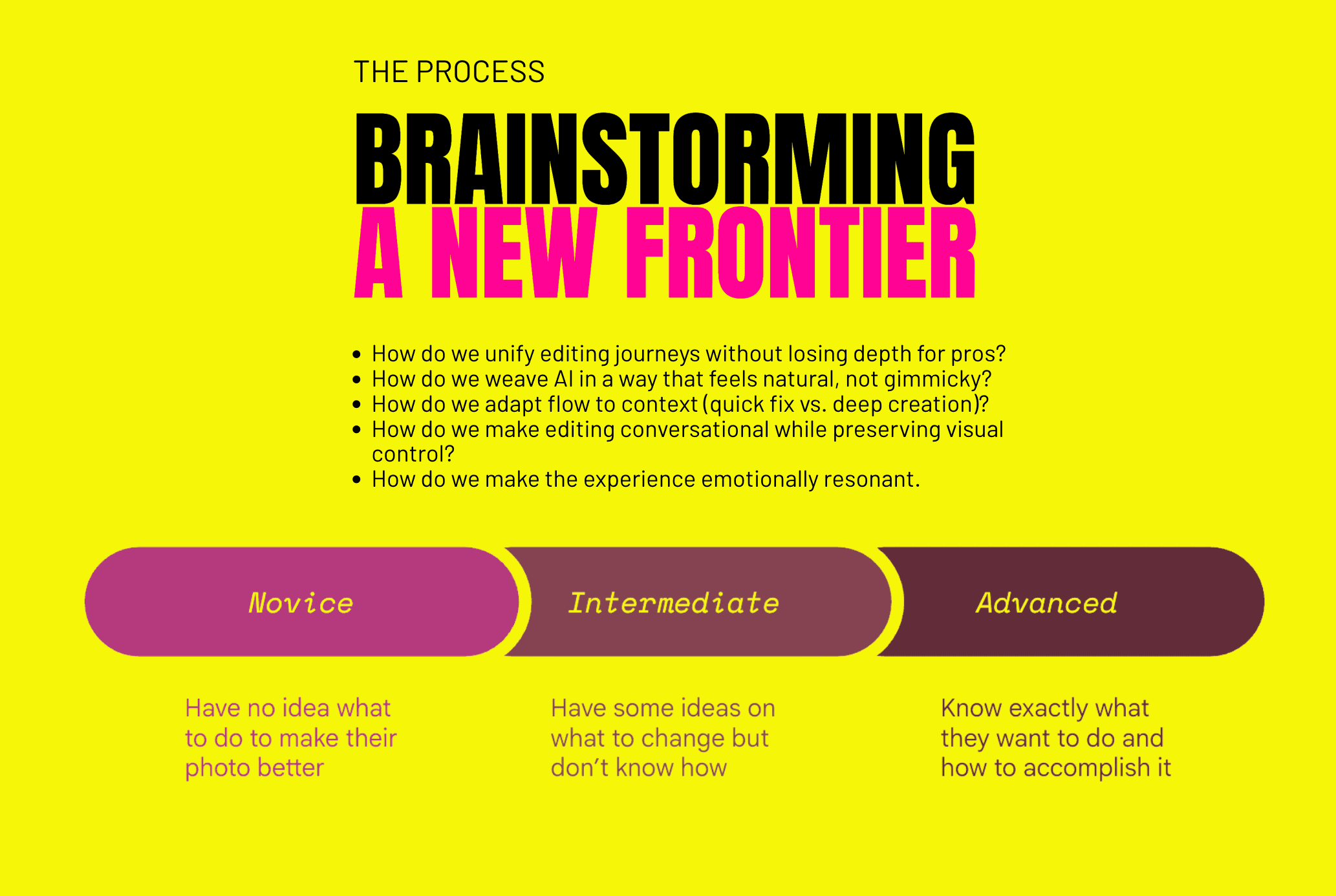
We set out to build what we called "Editor Next" - a reimagined editing experience that would work for three types of users:

  • Novice editors who have no idea what to do to make their photo better

  • Intermediate editors who have some ideas but don't know how to execute them

  • Advanced editors who know exactly what they want and how to accomplish it

The breakthrough insight: AI shouldn't replace creativity - it should amplify it. We designed three pathways into editing:

  1. Auto-pilot: Proactive suggestions before user input (AI recipes)

  2. Co-pilot: Guidance and interplay with user input (Active Canvas with smart suggestions)

  3. Manual: Full discovery of capabilities (comprehensive toolbox)

Building at Scale

This wasn't just a design challenge - it was an orchestration challenge. I partnered with Product, Engineering, Research, and Pixel Marketing to align everyone around a shared mission: "Make Photos the easiest place to edit your life beautifully."

We secured executive buy-in for a multi-year redesign investment. We rebuilt the backend architecture for scalability. We ran rapid prototyping and multi-region testing. We created design principles that became our North Star:

  • Focused Experience: Minimize UI to essentials, use progressive disclosure

  • Responsive Helpfulness: Proactively adapt to optimize for workflow and discovery

  • Encouraged Experimentation: Real-time preview and easy reversal of edits

The Launch

Conversational editing launched in September 2024 as part of a complete editing overhaul. The results spoke for themselves:

  • +135% increase in editing sessions in the first 3 months

  • +60% lift in tool discoverability

  • 53% of Pixel 10 buyers cited editing features as a key purchase driver

  • 40% reduction in time to edit for key flows

Wired called it "the rare AI feature people will actually use." TechCrunch and The Verge featured it as proof that AI could enhance creativity without replacing human agency.

What It Meant

This launch did more than ship a feature - it repositioned Google Photos from a storage utility into a creative platform. It became the foundation for our generative AI roadmap in 2025. And it proved that when you center users' actual needs and design with both empathy and rigor, you can build AI that people genuinely want to use.

Leading the Creative Expression mission taught me that innovation at scale requires equal parts vision and endurance. You need to align competing stakeholders, rebuild technical foundations, and stay focused on the experience you're building for real people - not just the technology that enables it.

The best products don't just work well. They feel like they understand you. That's what we built.

In September 2024, Google Photos launched a feature that felt like science fiction: ask your phone to edit your photo using natural language, and it just... does it.

"Blur the background." "Make this brighter." "Remove that person." No sliders, no menus, no guessing which tool does what. Just say what you want, and Google Photos handles the rest. I led the Creative Expression mission at Google Photos - the team responsible for editing, generative AI, and the Create Tab that serves over a billion users. This launch was the culmination of a multi-year effort to answer a deceptively simple question: How do you make professional-grade photo editing accessible to everyone?

The Problem

Google Photos had powerful editing tools, but they were hidden. Users didn't know what they needed to make their photos better, and even when they did, they couldn't find the right controls. 33% of surveyed users said they frequently lacked awareness of editing features in their apps. Even more reported not knowing what would make a photo look better.

We weren't alone in this problem - Apple Photos, Amazon Photos, VSCO, and Picsart all struggled with the same tension between simplicity and capability. But there was an opportunity: no gallery app had successfully bridged pro-grade editing with conversational ease.

The Vision

We set out to build what we called "Editor Next" - a reimagined editing experience that would work for three types of users:

  • Novice editors who have no idea what to do to make their photo better

  • Intermediate editors who have some ideas but don't know how to execute them

  • Advanced editors who know exactly what they want and how to accomplish it

The breakthrough insight: AI shouldn't replace creativity - it should amplify it. We designed three pathways into editing:

  1. Auto-pilot: Proactive suggestions before user input (AI recipes)

  2. Co-pilot: Guidance and interplay with user input (Active Canvas with smart suggestions)

  3. Manual: Full discovery of capabilities (comprehensive toolbox)

Building at Scale

This wasn't just a design challenge - it was an orchestration challenge. I partnered with Product, Engineering, Research, and Pixel Marketing to align everyone around a shared mission: "Make Photos the easiest place to edit your life beautifully."

We secured executive buy-in for a multi-year redesign investment. We rebuilt the backend architecture for scalability. We ran rapid prototyping and multi-region testing. We created design principles that became our North Star:

  • Focused Experience: Minimize UI to essentials, use progressive disclosure

  • Responsive Helpfulness: Proactively adapt to optimize for workflow and discovery

  • Encouraged Experimentation: Real-time preview and easy reversal of edits

The Launch

Conversational editing launched in September 2024 as part of a complete editing overhaul. The results spoke for themselves:

  • +135% increase in editing sessions in the first 3 months

  • +60% lift in tool discoverability

  • 53% of Pixel 10 buyers cited editing features as a key purchase driver

  • 40% reduction in time to edit for key flows

Wired called it "the rare AI feature people will actually use." TechCrunch and The Verge featured it as proof that AI could enhance creativity without replacing human agency.

What It Meant

This launch did more than ship a feature - it repositioned Google Photos from a storage utility into a creative platform. It became the foundation for our generative AI roadmap in 2025. And it proved that when you center users' actual needs and design with both empathy and rigor, you can build AI that people genuinely want to use.

Leading the Creative Expression mission taught me that innovation at scale requires equal parts vision and endurance. You need to align competing stakeholders, rebuild technical foundations, and stay focused on the experience you're building for real people - not just the technology that enables it.

The best products don't just work well. They feel like they understand you. That's what we built.

Let’s Make
Magic :)

Got a big idea, product, or message that needs to land? I work with teams ready to build things that connect and last. Reach out and let’s talk.

Contact us

Let’s Make
Magic :)

Got a big idea, product, or message that needs to land? I work with teams ready to build things that connect and last. Reach out and let’s talk.

Contact us

Let’s Make
Magic :)

Got a big idea, product, or message that needs to land? I work with teams ready to build things that connect and last. Reach out and let’s talk.

Contact us